
watch the on-demand recording here
Q1 2026 Compliance Update: Public Record Redactions & What Employers Need to Know
On February 26, 2026, Reference Services, Inc. (RSI) hosted our 30-minute Lunch & Learn webinar focused on one of the most significant shifts impacting background screening today: state-level public record redactions and the compliance challenges they create for employers.
As privacy laws evolve and courts limit access to personally identifiable information (PII), employers must understand how these changes affect hiring risk, Fair Credit Reporting Act (FCRA) compliance, and overall screening accuracy.
Why Public Record Redactions Matter
Across the country, states are increasingly redacting key identifiers from court records due to:
- Identity theft concerns
- Expanding privacy legislation
- Cybersecurity risks
- Consumer protection pressures
The result? The records still exist — but the identifiers traditionally used to match those records to candidates often do not.
This fundamentally changes how background screening must be conducted.
What Information Is Being Redacted?
Commonly removed or limited data elements now include:
- Full dates of birth (often reduced to birth year only)
- Social Security numbers (full or partial)
- Address history
- Middle names and suffixes
- Driver’s license numbers
Under the Fair Credit Reporting Act (FCRA), background screening providers must use reasonable procedures to ensure maximum possible accuracy. Historically, that has meant matching at least two identifiers — with RSI’s best practice being three.
When identifiers are missing:
- False positives (wrong person matched) increase
- False negatives (missed records) increase
- Disputes become more frequent
- Employer liability exposure grows
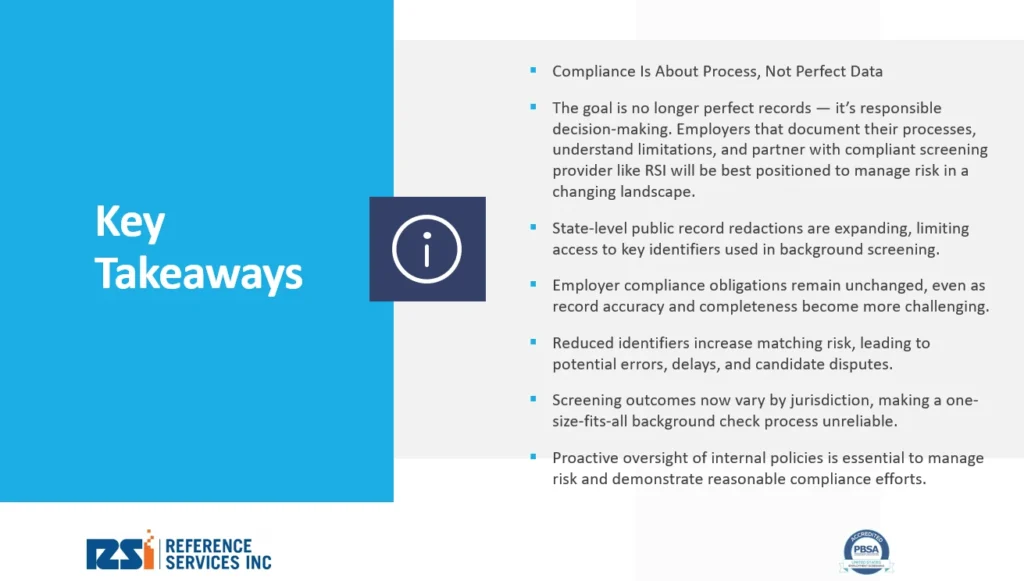
Compliance obligations do not change — even when the data does.
Real Compliance Risks for Employers
1. FCRA Exposure
Even with redacted records, employers remain responsible for:
- Ensuring maximum possible accuracy
- Following proper adverse action procedures
- Managing disputes appropriately
Incomplete data does not reduce your legal responsibility.
2. Adverse Action Risk
If a record is misattributed:
- A candidate may dispute
- Hiring decisions may be delayed
- Employers may face claims for wrongful denial or negligent hiring
3. Adverse Impact Concerns
Name-only or limited-data matching can disproportionately affect:
- Candidates with common names
- Certain ethnic or cultural groups
This raises potential Equal Employment Opportunity concerns and fairness issues in hiring practices.
How RSI Is Adapting to a Redacted Environment
While no provider can retrieve data that no longer exists, strong compliance processes can mitigate risk. RSI has implemented:
- Layered search methodologies
- Use of aliases and prior addresses (when legally permissible)
- Case-level verification and manual adjudication
- Jurisdiction-specific workflows
- Expanded statewide + county-level search combinations
- Biometric identity verification tools
The focus has shifted from data access to process integrity.
What Employers Should Be Doing Now
Review Your Policies
Ensure your background screening policies:
- Reflect current public record limitations
- Avoid over-reliance on “clean record” assumptions
- Address inconclusive or potential match procedures
Strengthen Adverse Action Workflows
- Confirm your pre-adverse and final adverse processes are airtight
- Document all communication
- Partner closely with your screening provider on disputes
Prepare for Delays & Disputes
Redactions often result in:
- More “gray area” findings
- Increased candidate questions
- Longer hiring timelines
Training HR teams on escalation procedures and documentation is now essential.
The Future Outlook
We expect to see:
- More states adopting redaction-first policies
- Expanded privacy legislation
- Reduced reliance on static public records
- Increased scrutiny of employer decision-making processes
- Continued expansion of Ban the Box laws
The compliance landscape is shifting from data-driven certainty to process-driven defensibility.
Key Takeaway
Compliance is no longer about having perfect data — it’s about proving you handled imperfect data responsibly.
Employers who:
- Understand the limitations of redacted records
- Document their decision-making processes
- Partner with a compliant, process-driven screening provider
…will be best positioned to manage risk in this evolving environment.
If you missed the webinar or would like to discuss how these changes impact your screening program, contact our compliance team at:
📩 compliance@referenceservices.com
Reference Services, Inc.
Trusted. Accurate. Compliant.
General Help: help@referenceservices.com
PDF copy of our presentation here: Q1 Compliance Update – Public Record Redactions
Reference Services, Inc. is dedicated to ensuring client satisfaction by delivering exceptional customer service. Our U.S.-based team offers solutions designed to help clients build a safe, productive, and dependable workforce, utilizing cutting-edge technology. With our expertise and experience, RSI provides swift and precise reports at an unmatched value.
Our promise to you – QUALITY data with the industry’s best accuracy, SPEED with reports returned within hours, SIMPLICITY with easy-to-use software & integrated ATS, and CUSTOMER SERVICE beyond your expectations.